| Aircraft & datalink Watch the sky and read what the planes are sending |
|---|
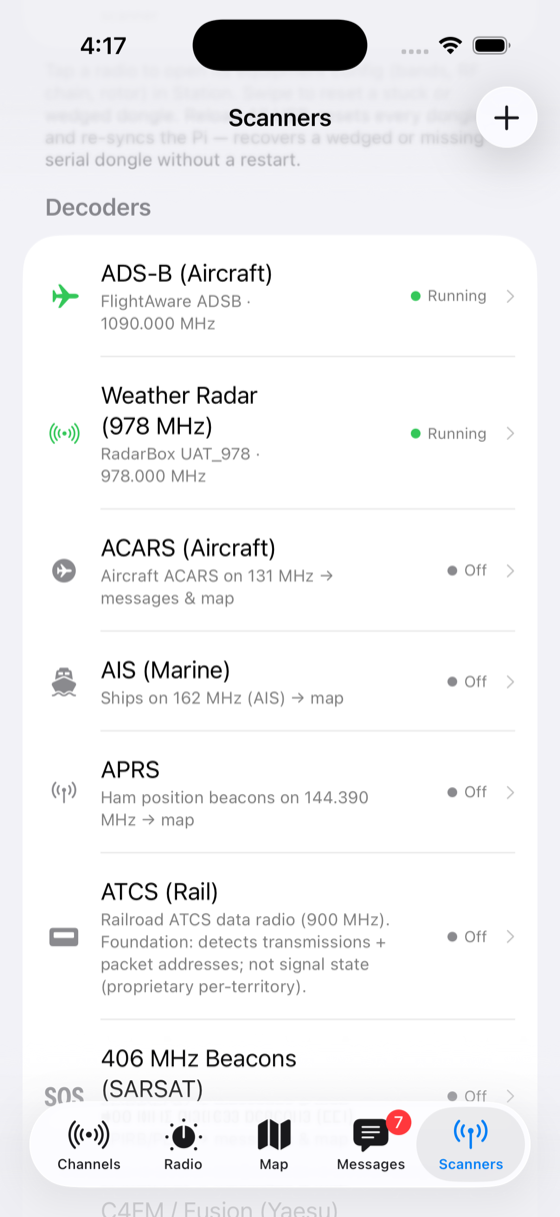
| ADS-B | 1090 MHz | Live aircraft — position, altitude, speed and callsign — plotted as they fly over. | ✓ | – | – |
| UAT | 978 MHz | The US low-altitude ADS-B link, plus FIS-B: NEXRAD weather radar and aviation notices straight off the datalink. | ✓ | – | – |
| ACARS | VHF | Aircraft-to-ground text — position reports, OOOI times and free-text — enriched with the flight and route. | – | – | – |
| VDL Mode 2 | VHF | The faster VHF datalink replacing ACARS, decoded to positions and messages. | ✓ | – | – |
| Ships & marine Follow vessels and the VHF that guides them |
|---|
| AIS | 161–162 MHz | Ships tracked live — name, position, course and speed. | ✓ | – | – |
| DSC | VHF / HF | Marine Digital Selective Calling: distress, routine and position calls, decoded and mapped. | ✓ | – | – |
| NAVTEX | 518 kHz | Marine safety text — weather, warnings and navigational notices, printed as they arrive. | – | – | – |
| Digital voice The three digital modes, decoded to audio |
|---|
| DMR | VHF / UHF | Digital voice with each over threaded by callsign, name, talkgroup and ID — plus a live net finder. | – | – | – |
| Fusion (C4FM) | VHF / UHF | Yaesu System Fusion digital voice, decoded straight to audio. | – | – | – |
| D-STAR | VHF / UHF | Icom's digital voice and callsign routing, decoded to audio. | – | – | – |
| Weak-signal & keyboard modes The digital HF fringe — and the classics that never left |
|---|
| FT8 | HF / VHF | The dominant weak-signal mode — callsign, grid and SNR — feeding the map and propagation view. | ✓ | – | – |
| FT4 | HF | FT8's faster cousin, built for contest run rates. | – | – | – |
| JS8 | HF | Weak-signal keyboard messaging built on the FT8 engine. | – | – | – |
| MSK144 | VHF | Meteor-scatter — catch the brief ping as a trail ionizes on 6 m and 2 m. | – | – | – |
| Q65 | HF / VHF | A slow, robust weak-signal mode for EME, tropo and ionospheric scatter. | – | – | – |
| JT65 | HF / VHF | The classic slow weak-signal mode that started the WSJT family. | – | – | – |
| WSPR | HF | Whisper-quiet propagation beacons — see where your band is actually reaching. | ✓ | – | – |
| PSK31 | HF | The classic HF keyboard chat mode, decoded across the whole passband at once. | – | – | ✓ |
| RTTY | HF | Radioteletype — still busy in contests and utility traffic — every signal decoded in parallel. | – | – | ✓ |
| CW · Morse | HF / VHF | A rebuilt CW decoder — matched filter, bounded AFC and AGC — turning clean Morse into text. | – | – | ✓ |
| Pictures off the air Signals that resolve into an image |
|---|
| SSTV | HF / VHF | Slow-scan TV, decoded as the picture paints — including ISS passes. | – | ✓ | – |
| HF WEFAX | HF | Radiofax weather charts, painted line by line off the shortwave broadcast on schedule. | – | ✓ | – |
| Meteor LRPT | 137 MHz | Full-resolution weather-satellite images off the Meteor-M2 downlink. | – | ✓ | – |
| Data, telemetry & safety Packets, beacons and the machines that talk |
|---|
| APRS | 144.39 MHz | The 2 m packet network — position and MIC-E beacons, balloons, and satellite APRS passes. | ✓ | ✓ | – |
| Radiosondes | 400–406 MHz | Weather balloons from their onboard GPS — mapped and rotor-tracked; auto-armed for the launch window. | ✓ | ✓ | – |
| POCSAG · FLEX | VHF / UHF | Pager traffic decoded to text, including public-safety dispatch paging. | – | – | – |
| ATCS | UHF | Railroad Advanced Train Control signaling — the data that runs the trains. | – | – | – |
| EOT / HOT | UHF | End-of-train and head-of-train telemetry packets. | – | – | – |
| Utility meters | 433 / 915 MHz | rtl_433 reads of smart utility meters and the 433 MHz sensors around a neighborhood. | – | – | – |
| 406 MHz beacons | 406 MHz | Emergency EPIRB, ELT and PLB distress beacons, identified by registration. | ✓ | – | – |
| Weather & alerts The atmosphere, straight off the air |
|---|
| SAME · EAS | 162 MHz | NOAA Weather Radio alert decoding — your county's warnings, matched by FIPS code. | – | – | – |
| NOAA Weather Radio | 162 MHz | The continuous VHF weather broadcast as clean audio, the source the SAME alerts ride on. | – | – | – |